


When choosing powder materials for SLS (Selective Laser Sintering), understanding the mechanical and thermal properties of each material is crucial. The five parameters presented in this comparison—tensile strength, flexural strength, elongation at break, heat deflection temperature (HDT), and refresh ratio—have been carefully selected to reflect the properties that most influence the SLS process.
These parameters allow for the evaluation of powder suitability in various applications. They provide a balanced perspective on mechanical properties, thermal resistance, and economic efficiency—key factors for engineers, designers, and production managers in selecting the right material for specific needs.
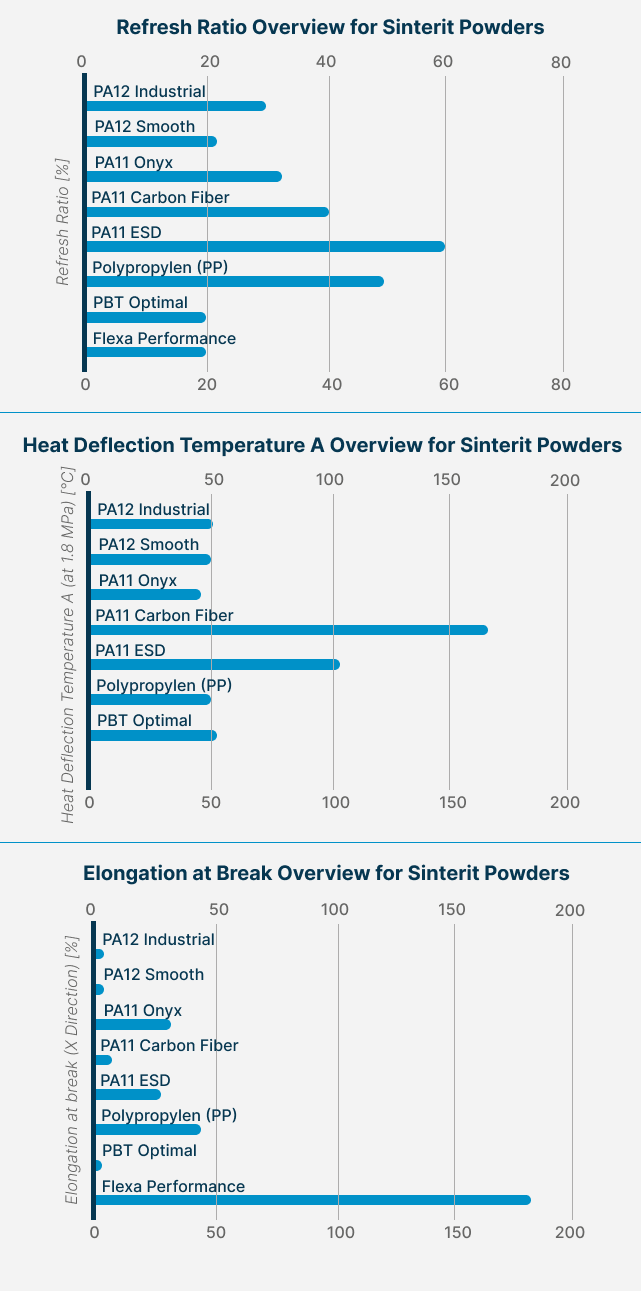
| Powder 粉末 | Tensile Strength 拉伸强度 (X) [MPa] | Flexural Strength 彎曲强度 (X) [MPa] | Elongation at Break 斷裂伸長率 (X) [%] | Heat Deflection Temp A 熱變形溫度A (1.8MPa) [℃] | Refresh Ratio 刷新率 [%] |
|---|---|---|---|---|---|
|
PA12 Industrial | 47.61 | 62.31 | 5.86 | 51 | 30 |
|
PA12 Smooth | 38.44 | 49.18 | 4.55 | 50 | 22 |
|
PA11 Onyx | 55.00 | 54.20 | 31.60 | 47 | 33 |
|
PA11 Carbon Fiber | 65.93 | 87.35 | 8.23 | 167 | 40 |
|
PA11 ESD | 50.00 | 56.00 | 28.00 | 103 | 60 |
|
Polypropylen (PP) | 19.30 | 25.60 | 44.40 | 50 | 50 |
|
PBT Optimal | 49.04 | 52.08 | 2.56 | 52 | 20 |
|
Flexa Performance | 7.99 | - | 182.63 | - | 20 |
| Key Technical Parameter Explanations
1. Tensile Strength
Indicates the maximum stress a material can withstand when stretched before breaking. For users, this reflects the tensile or pulling resistance of printed parts—crucial for snap-fits, enclosures, and structural elements.
2. Flexural Strength
Measures the bending force a material can withstand before failure. This is important for slender or beam-like components that may bend or buckle during use.
3. Elongation at Break
Represents how much a material can stretch before breaking—a measure of flexibility or ductility. High values = flexible and impact-resistant parts. Low values = stiff and brittle.
4. Heat Deflection Temperature A (HDT A)
This indicates the temperature at which a material begins to deform under stress. A high HDT means the part is suitable for high-temperature environments, such as engine compartments or electronic enclosures.
5. Refresh Ratio
Describes how much fresh powder needs to be added to old material to maintain print quality. Lower values indicate lower powder usage costs and higher sustainability.
 No matter the challenge, Sinterit powders, combined with Sinterit Studio software, provide customized solutions for precise, professional-grade SLS printing.
| Material Highlights by Key Performance Parameters
· Tensile Strength
PA11 Carbon Fiber (65.93 MPa) ➡ Has the highest tensile strength - ideal for structural load-bearing components.
· Flexural Strength
PA11 Carbon Fiber (87.35 MPa) ➡ Has excellent bending resistance - ideal for parts like brackets, frames, and enclosures.
· Elongation at Break
Flexa Performance (182.63%) ➡ Excellent flexibility – recommended for hinges, seals, and shock-absorbing elements. On the other hand, PBT Optimal (2.56%) ➡ Exceptional stiffness, suitable for all applications requiring high rigidity.
· Heat Deflection Temperature A (HDT A)
PA11 Carbon Fiber (167°C) ➡ High temperature resistance - ideal for technical or automotive applications.
· Refresh Ratio
PBT Optimal (20%)➡ Most cost-effective powder reuse – ideal for economical prototyping workflows.
To order Sinterit related products, please click below to contact us
👉Learn more about Sinterit products
- Contact Us -
3DMart offers more than just 3D printing; we provide three major OEM services: "3D printing contract manufacturing", "3D scanning service", and "3D spatial scanning service"!
Follow our fan pages to stay updated:
Facebook | Instagram | Threads
Reference